Sunday, June 19, 2005

Happy Father's Day

"And, ye fathers, provoke not your children
to wrath: but bring them up in the nurture
and admonition of the Lord."
~Ephesians 6:4~
When I am:
  • Four years old: My daddy can do anything.
  • Five years old: My daddy knows a whole lot.
  • Six years old: My dad is smarter than your dad.
  • Eight years old: My dad doesn't know exactly everything.
  • Ten years old: In the olden days, when my dad grew up, things were sure different.
  • Twelve years old: Oh, well, naturally, Dad doesn't know anything about that. He is too old to remember his childhood.
  • Fourteen years old: Don't pay any attention to my dad. He is so old-fashioned.
  • Twenty-one years old: Him? My Lord, he's hopelessly out of date.
  • Twenty-five years old: Dad knows about it, but then he should, because he has been around so long.
  • Thirty years old: Maybe we should ask Dad what he thinks. After all, he's had a lot of experience.
  • Thirty-five years old: I'm not doing a single thing until I talk to Dad.
  • Forty years old: I wonder how Dad would have handled it. He was so wise.
  • Fifty years old: I'd give anything if Dad were here now so I could talk this over with him. Too bad I didn't appreciate how smart he was. I could have learned a lot from him.

Father's Day Web Sites

What's a Dad
Annie's Fathers' Day Page
Happy Father's Day by CharleneDazzle Lady's Father's Day
Jess Cannon's Home PageCyber Grandma's Happy Father's Day
The Holiday Spot
Alphabet Soup's Father's Day
Billy Bear's Happy Father's Day

Saturday, June 18, 2005

How to Clean Your Computer Screen

When your computer screen gets all dusty and smeared, here is a solution. This automatic screen-cleaner will do the job. It's so good, you wonder why you had not thought of it yourself. No, you don't have to purchase anything. If you don't already have one of these at home, you can usually find them for free somewhere. Check it out here.

Trackedback at basil's blog.

Wednesday, June 15, 2005

The Quest for Light

Why do we seek the light? We seek light, because light is good. How do we know that light is good? Because God told us that it was so.
"In the beginning God created the heaven and the earth. And the earth was without form, and void; and darkness was upon the face of the deep. And the Spirit of God moved upon the face of the waters. And God said, Let there be light: and there was light. And God saw the light, that it was good: and God divided the light from the darkness." ~~The Book of Genesis, from The Holy Bible, King James Version
Continue to seek the light and avoid the darkness.

The June Bug has Bitten

When the summer sun shines brightly and the humidity drenches like a gentle rain from heaven, when the air smells like unseen snakes, and the petals of flowers glisten like colorful jewels, it is at that time that I hear the call of my garden, and I am powerless to resist.
"June bring tulips, lilies, roses.
Fills the children's hands with posies." .... Sarah Coleridge

Sunday, June 12, 2005

The Quest for Magic

A MagiQuest Adventure - by Neddy 
Performing wondrous feats of magic at MagiQuest, requires a magic wand. Without a wand, magic cannot be summoned forth. Each wizard uses his or her personal wand, although other wizards' wands can be used when borrowed or captured. When selecting a personal wand, one must experiment with many wands until one is found that will create magic when waved by that particular wizard. The exterior of the wands seems to be hand carved of an exotic wood, but it is the core of the wand which has the power. The core is believed to be manufactured of an organic, magical object or substance. Most believe that the cores or insides of the wands contain some rare tail feathers from the mythical phoenix and a few hairs of the mane from the now extinct unicorn. Those substances are then padded with snips of silk from gowns of veelas, which are then wrapped tightly with dragon heartstrings. The more powerful wands available at MagiQuest give very strange effects (Priori Incantatem) when used by true believers, because each of those wands contains a tail feather from Fawkesguy, the famous phoenix that belongs to Quest Master Dumbledorph, the headmaster of MagiQuest's School of Wizardry. Quest Master Dumbledorph is a former pupil of the infamous headmaster in the wildly popular adventure book by J.K. Rowling about the "The Boy Who Lived".
A MagiQuest Adventure  

The Kingdom of MagiQuest is at Broadway at the Beach, in the coastal resort of Myrtle Beach, deep in the principality of South Carolina. All round and about the Kingdom, lay damp and hot swamps, inhabited by slithering noots and scamanders, chomping alligarooes and wildeboars, and other fantastic beasties, but within the castle walls of MagiQuest, one discovers ever more mysterious things, for which there exists NO explanation, other than the power of the magic that is bestowed upon faithful believers and their wands.  
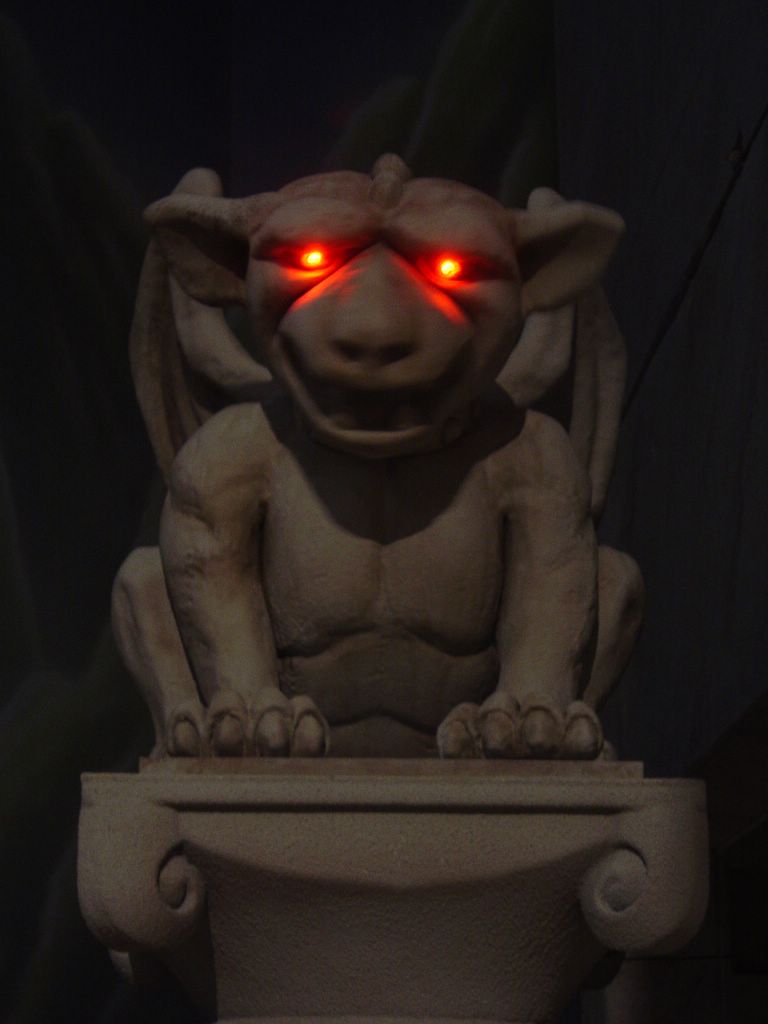
Gargoylian the Good, Guardian of the MagicQuest Crypt, will guide you through the Kingdom. The pure of heart have no need to be afraid.  
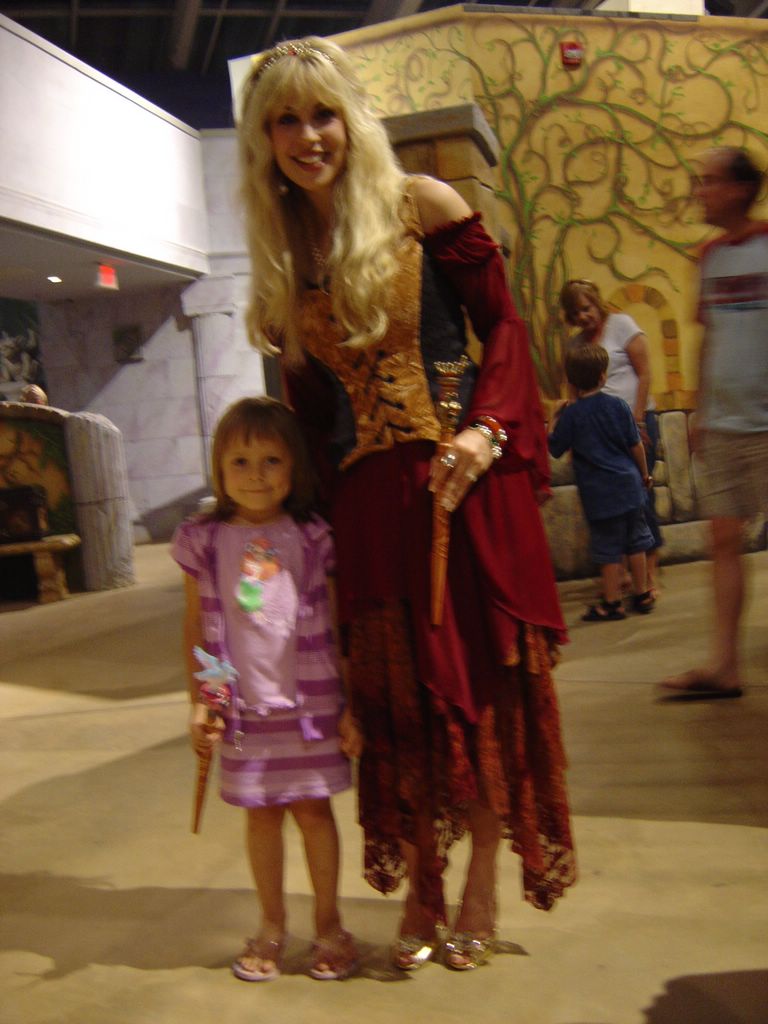
Contessa Joliblonda is the NoosCaster and official MagiCryer of MagiQuest. However, should trouble arise, she is well prepared for her other valued role at MagiQuest, the sword-armed Defender of the Faithful.
   
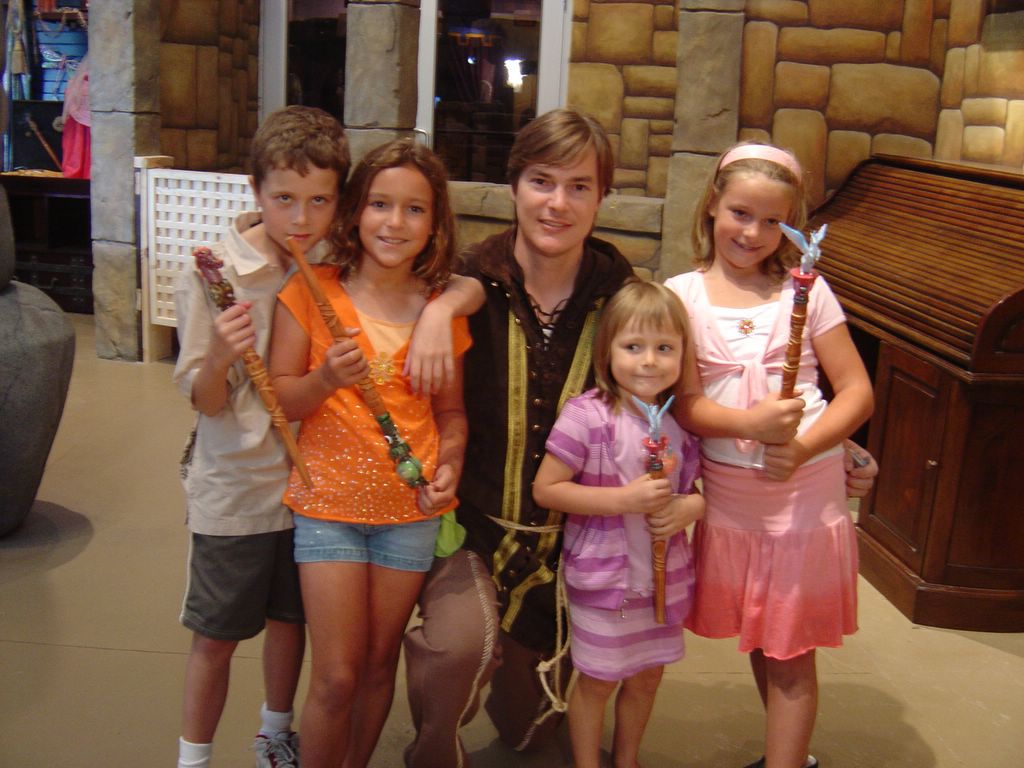
Master Wizard Jonargylius, the inventor of the MagiQuest wand, delights in meeting new Wizards-in-Training, as they learn to twirl and swirl and their beautiful magic wands.  
Squibby Isbelinha sits in the Giant's chair, unafraid, and also unaware, of the consequences. She has come to the Kingdom on a quest to find the famous unicorn that was lost long, long ago by her mother, Princessa Isbelao.
 
Princess Candice, the granddaughter of Quest Master Dumbledorph, rescued Squibby Isbelinha from the dangers of the Giant's chair, and then instructed the tiny Wizard-to-Be about the mysteries of magic-wanding. Together they roamed the Kingdom, in quest of the long lost unicorn. 


While on safari at the savannah west of the MagiKingdom, Wizard Djavidian, captured a furious pride of native carolions. After training them as cavaliers and providing them with uniforms, he formed the Band of MagiQuestrians. The Lilliputian leader then commanded the MagiCavalry to mount their unicorn steeds and to charge into battle. The trained warriors obeyed their heroic leader with gusto, waving their mystical wands on high, employing them as powerful weapons to vanquish all evil from the Kingdom. Meanwhile, Wizardess Rheanna was questing her way through the land, and paused for a moment of reflection while she sought guidance from a  higher source.


The Good Fairy Godmother soon apparated in answer to the pleadings of the young wizardess and blessed Rheanna with a Spell of Hope.  
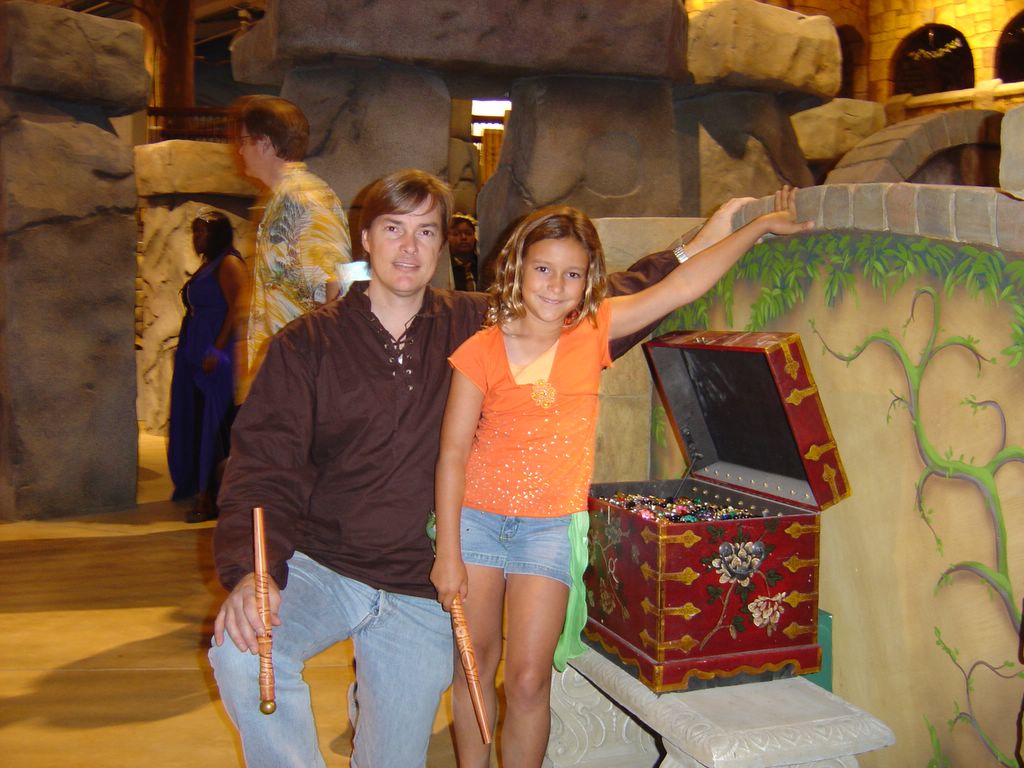
Wizardess Rheanna continued her quest with great success, discovering the Treasure Chest. With a Wave of her Wand, the chest opened itself, and awarded Rheanna with gold, jewels and priceless heirlooms which had been plundered from the Marauding Infidels. She also won the praise and admiration of Jonargylius, Master Wizard Inventor. 

Wizard Djavidian shows off the now kingdom-famous-wand that boggled the brains of the Wizards of MagiQuest. THEN IT HAPPENED!

Wizard Djavidian's wand became so powerful that it affected the entire Kingdom of MagiQuest. Djavidian's magic overwhelmed the magic of lesser wizards and caused very strange happenings throughout the Kingdom. Lights flickered, thunder roared. The Kingdom rocked upon its firm foundations. Even the all-knowing, all-seeing Quest Master of the MagiQuest Wizards' School was shocked and dumbfounded. Collapsing into a gelatinous blob, he vowed not to restore himself until all was righted in the Kingdom. There became such consternation inside the once peaceable kingdom, that Whopper Wizards were called upon to analyze the discombobulation and wizardize a solution to return MagiQuest to its former glory.

 
Djavidian's wacky wizardry caused an apparition of a False Fairy Godmother at the Giant's chair, where sat the Giant, Avo-Heathcliff. She spun a trouble spell upon him, and thenceforth, the magic power of his wand waned. Nothing the wizards schemed could restore the mystical powers to it and most believe it was because Avo-Heathcliff lost faith, due to Djavidian's wacky wand and the fright of seeing the False Fairy Godmother. Without his powerful wand, Avo-Heathcliff became dispirited and sprinkled himself and all the little Wizards-in-Training with floo powder. Yonder and away they flooed on giant matchsticks. He forced them to drink a trujuice potion so that they would reveal all the secrets of MagiQuest that they had learned. The next day, Avo-Heathcliff flooed all of them back to the fantastic Kingdom, where he ordered the little Wizards-in-Training to capture Wizard Djavidian's super powered wand. However, once the little wizards succeeded in pinching the wand from the warrior, they guarded it from the Giant, and righteously returned it to the MagiQuest Proprietors, where the Whopper Wizards replaced it with a wand of normal magic, which was then given to Djavidian. Avo-Heathcliff was awarded a new magic wand after he surrendered all the floo powder that was hidden in his trouser cuffs. Squibby Isbelinha finally caught a fleeting glimpse of her mother's long lost unicorn. Isbelinha tightly closed her eyes and made an earnest and sincere wish upon her wand. As soon as she opened her eyes, she and Princess Candice gazed upwards and upon the castle ramparts they saw, slowly prancing, the famous mythical beast. Almost instantly he magically disappeared and was gone, as unicorns are wont to do. However, Squibby Isbelinha's heart was full of joy and gratitude that her lifelong quest had been granted. All the little Wizards-in-Training were graduated with "highcum magus" honorifics from the MagiQuest Wizardry School. Avo-Heathcliff's treasure quests became quite successful, as he learned to avoid the False Fairy Godmother whenever he spotted her. When she attempted to cast trouble spells upon others he warned them of her mystical mischief. Thenceforth and forever more, all was well within the MagiKingdom and all of Wizardom knew naught but joy and happiness. All, that is, except the False Fairy Godmother. The Whopper Wizards cast all the remaining floo powder at her, and furiously flapping her powdered fairy wings, she flooed right through MagiQuest's Window of No Return. The End!--- of Ava-Neddy's MagiQuest Adventure.

Saturday, June 11, 2005

Life Echoes Through Eternity

'What We Do In Life Echoes Through Eternity' ~Maximus, The Gladiator

Maximus, in the Oscar winning movie, "The Gladiator", uttered these profound words as a call for heroism. Whatever we accomplish in this life will be the legacy we leave for future generations of the world, whether to cherish or to rue. We can effect the world for the better by listening to our inner voices, standing tall and striving to reach the higher yearnings of our souls.

In other words - "that's why we blog".

Thursday, June 09, 2005

The Magic Wand


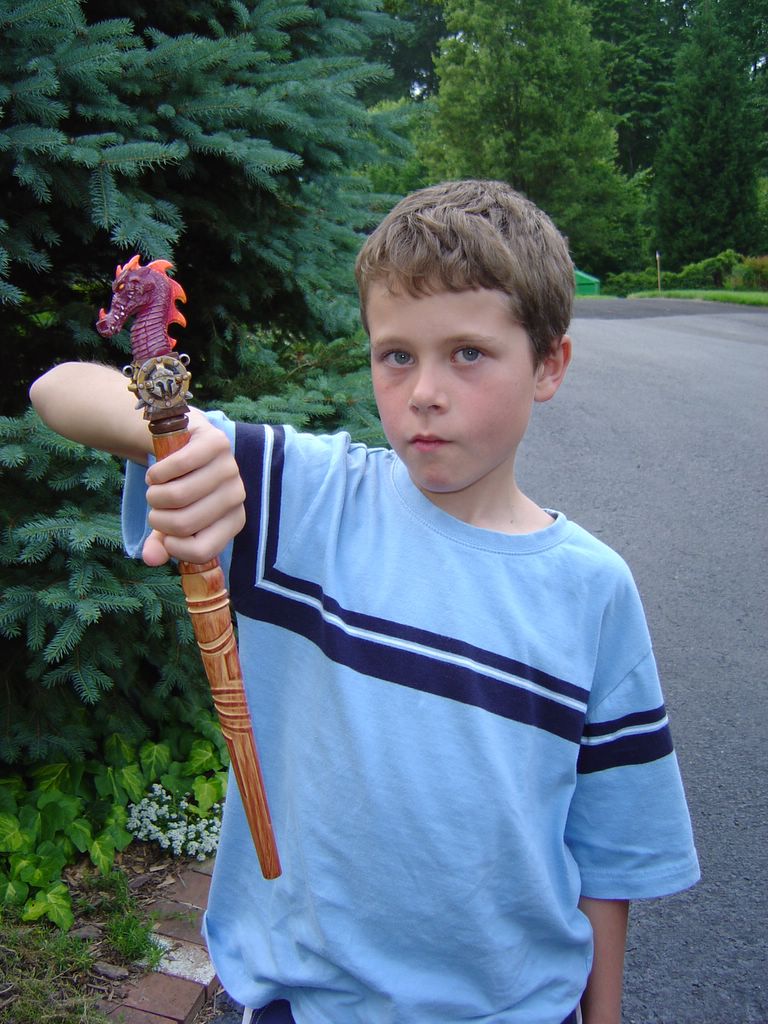
This young man is now a Magi and he is showing off his Magic Wand that he took home from the MagiQuest Adventure in Myrtle Beach. His family took him there for his ninth birthday and after attending the Magic Wand school taught by the QuestMaster he received this "dragon" wand with which he was able to make magic in the land of MagiQuest. Magi choose their wands and customize them according to their personalities. When he returns to MagiQuest he will be able to increase his magical skills and increase his powers and game levels. Even though he takes his wand home, it has the power to remember everything he accomplished at MagiQuest, so he will not need to start over! This special magic wand stores all of his adventures and discoveries so that when he returns he will be able to use it again to increase his magician's skill. The magic wand at Magiquest is really magic!

CLICK on image for a close up view.
,

Wednesday, June 08, 2005

Bats Alive!

Now there is another reason to be grateful you do not live in Iowa. Aside from avoiding tornadoes and NOT having to plant elephant eye corn, you can also live free from bats in all the other forty-nine states of the Union. How grand. The average Iowa home that requires de-batting usually has as many as 150 bats, although some homes are hosting colonies of close to 1,000. However, don't believe for one moment that the Iowans are being driven batty. They are not! They do not even know the bats are in their belfries.
Experts Say Bats Living in Most Iowa Homes: Experts Say Bats Are Living in the Majority of Iowa Homes Without Owners Knowing It

"BADGER, Iowa Jun 6, 2005 — Bats live in the majority of Iowa homes without the owners even knowing it, experts with the Iowa Department of Natural Resources said. They live in chimneys, attics and crawl spaces, and usually don't drive homeowners batty if they remain in those uninhabited areas, said Mark McInroy, a DNR technician. Experts don't know how many bats live in Iowa or whether the bat population is changing."

Monday, June 06, 2005

The Magic Quest

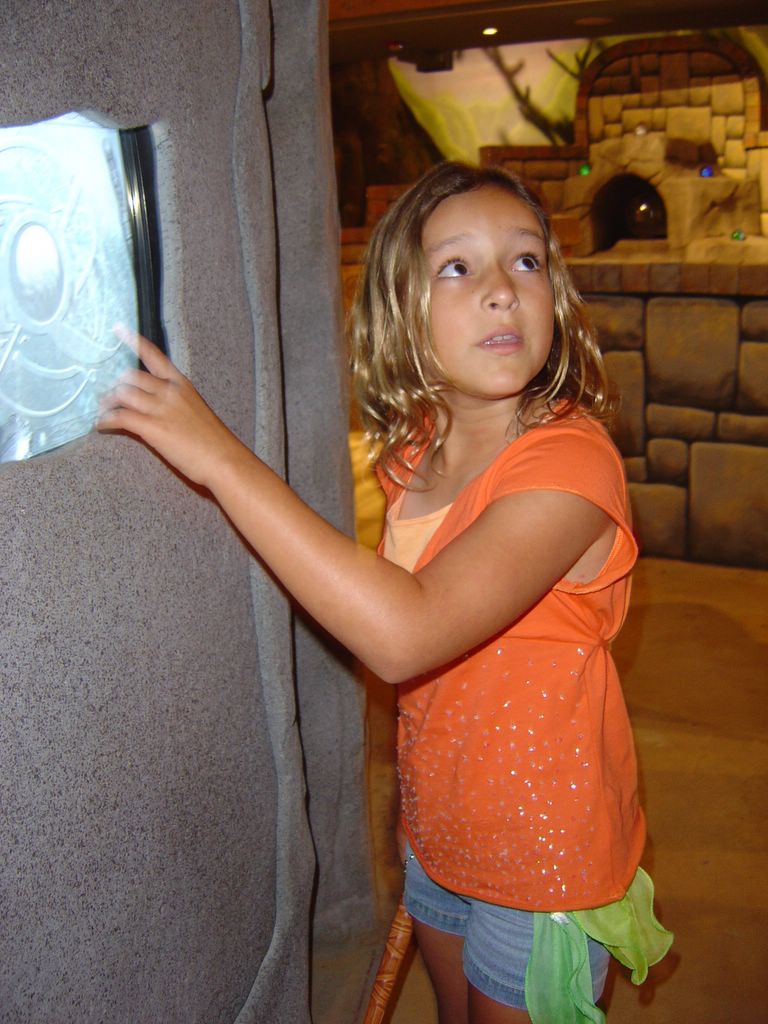
For A Real Magic Wand - has been fulfilled! This week-end my family motored south for seven and one half hours to attend the opening day of MagiQuest at Myrtle Beach. My grandson had his ninth birthday and he is an avid fan of the Harry Potter adventure series. He has read each book from cover to cover. Amazing, isn't it? This wonderful adventure park was indeed made for him. He received a unique magic wand in honor of his birthday at the Magic Wand Tree. With it my grandson was able to choose his own customized journey through MagiQuest land, fighting dragons, finding fairies, helping unicorns, and escaping the trickster and shadow creatures. Beforehand the participants were given instructions at a school by the Quest Master on the proper use of the mysteries of the magic wand and they practiced opening treasure chests and illuminating crystals and stones. My grandson collected runes and renewed his wand's powers at the ancient Stonehenge.
"What's new? Harry Potter wannabes can get a taste of the magical life at MagiQuest, an interactive family attraction opening June 4 at Broadway at the Beach. Each player gets a personal magic wand that can set off lightning bolts, open treasure chests and perform heroic deeds in a lifesize video game that requires teamwork, skill and imagination." InsideNova.com
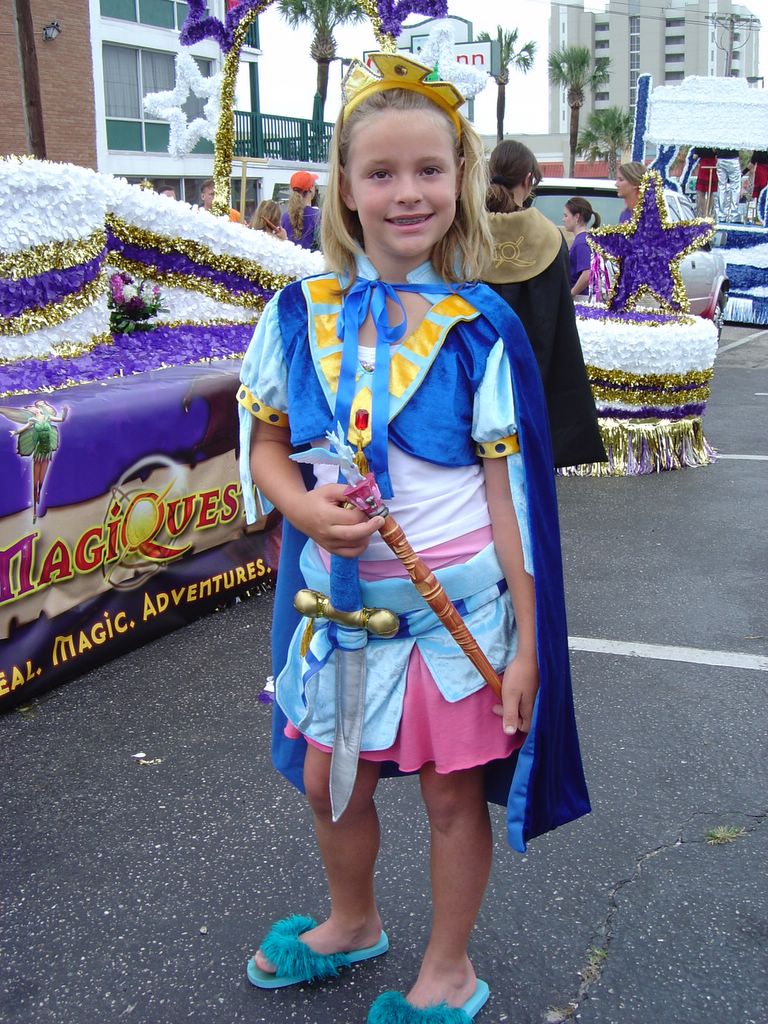
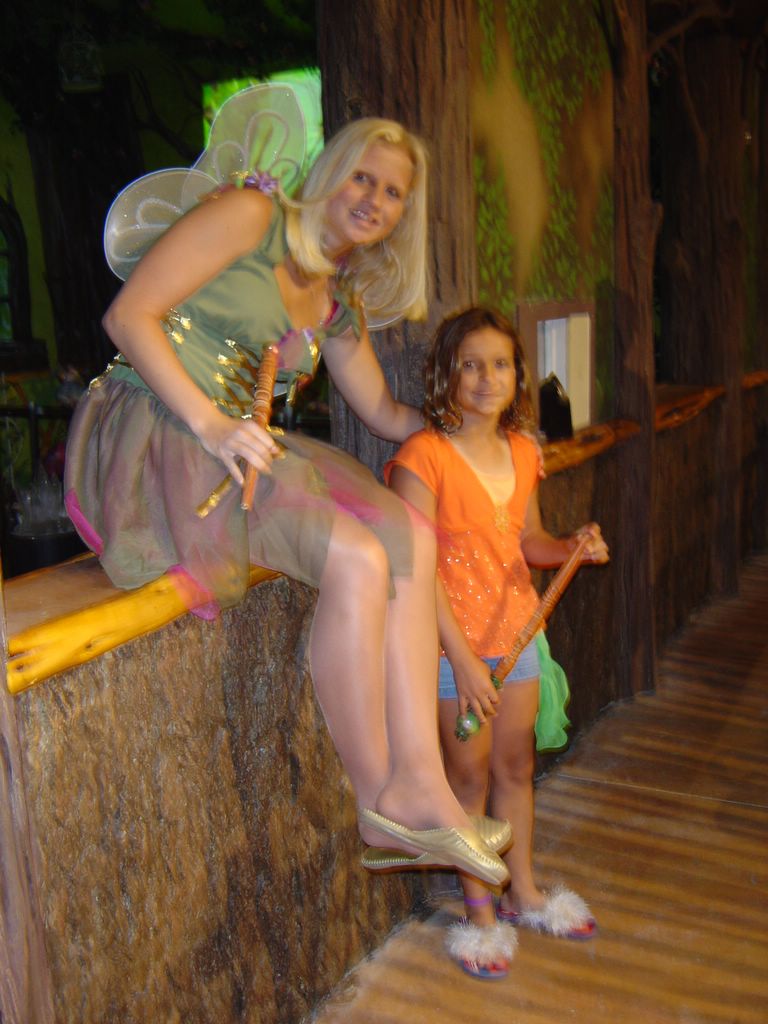
My granddaughters met the Princess of MagiQuest, Princess Candice, and we brought home a new cd album that she recorded exclusively for MagiQuest, and its believers in magic and the celebration of individuality. It is quite fascinating for a child, an adult, or even a princess (as shown here) to wield a real magic wand, with real powers.
Renaissance Music Star Candice Night Creates Royal Harmony With Magical Family Entertainment Venue

"MYRTLE BEACH, SC - MAY 2, 2005 - Singer and songwriter Candice Night has teamed up with New Kingdoms, LLC, on a new business venture that brings magic back to families and features Night as a fictional character in a new, magical amusement venue. "Candice Night, has agreed to take on the role of Princess Candice, one of the main characters of New Kingdom's amusement venue MagiQuest, an innovative, interactive family entertainment concept that puts its guests in the physical world of a video game. As Princess Candice, Night portrays the singing princess who uses songs and magic to produce healing stars throughout the land of MagiQuest. Doubling as a Master Magi, the highest level a person can achieve in the game of MagiQuest, Princess Candice encourages children to believe in themselves by using their own creativity and the magic that is inside them. "Night and MagiQuest's partnership includes using Night's likeness as part of the game and in promotional materials. Night will make appearances as Princess Candice at the Grand Opening Celebration of MagiQuest's first location in Myrtle Beach, S.C., on June 15 and plans are underway to include Night in a medieval festival that will take place in the fall. Night also wrote and recorded the theme song to MagiQuest."

Thursday, June 02, 2005

Save Freedom of Worship

This poster from another time in the history of our country tells quite a story. Freedom of worship was valued and protected. Today there is a war going on against that freedom. The first amendment is supposed to guarantee our freedom of religion, yet nowhere in the bill are the words: "separation", "church", or "state". Isn't that amazing? Thomas Jefferson wrote a letter quoting the first amendment, and attached the Baptist term " separation of church and state" after the quote.

"January 1, 1802, by Thomas Jefferson to the Danbury Baptist Association of Connecticut: I contemplate with solemn reverence that act of the whole American people which declared that their legislature should "make no law respecting an establishment of religion, or prohibiting the free exercise thereof," thus building a wall of separation between Church and State.
Jefferson was attempting to remove all fears that the government would make dictates to the somewhat outcast Baptist church, therefore he established common ground with them by using the words of Roger Williams, one of their most prominent preachers. Even more amazing it is that those Baptists understood the "wall" was to protect the church from the state, not vice versa, as is happening today. The first amendment that Jefferson quoted, in the U.S. Constitution, is supposed to protect the churches from the state, but it doesn't seem to be working very well for Christian churches.

Haloscan commenting and trackback have been added to this blog, which means that all of the previous comments are gone. However, they are NOT forgotten, neither are they lost. I just need to learn how to find them and how to re - post them:
Trackbacked at The Mudville Gazette and Wizbang's CARNIVAL OF THE TRACKBACKS, XV

Wednesday, June 01, 2005

BELIEVE Your Eyes!

Stare at the four dots in the middle of the inking image below for 30 seconds. Then either close your eyes, or just look at the white space beside the inking. Wait just a couple of seconds. What do you see? OR ......
1) Relax and lazily stare at the 4 tiny dots in the picture
below for at least 30 seconds.

2) Slowly shift your gaze from the screen to a wall near you.

3) You will see a circle of light formed on the wall.

4) Start blinking and continue till you see a figure within the circle.

5) BELIEVE!


No Need to Click Here - I'm just claiming my feed at Feedster

Tuesday, May 31, 2005

Cheerio from Samuel Pepys

On this day, in the year of our Lord, 1669, citing poor eyesight, Samuel Pepys recorded the last event in his diary. A great loss to the English speaking world's erudition of life in the 17th century, yet without his meticulus writing of the diary in the first place, we would know even less of everyday London life. Just in case you are wondering, he pronounced his name as "Peeps".

Who was Samuel Pepys?

Samuel Pepys was born in London on 23 February 1633, the fifth of eleven children, although by the time he was seven only three of his siblings, all younger, had survived. He was sent to grammar school at Huntingdon during the English Civil War (1642-1651), returning later to London and attending St Paul’s School. Following this he went to Cambridge where he attended Trinity Hall and then Magdalene colleges. Not long after taking his degree in 1654 he was employed as secretary in London by Edward Mountagu, a distant relative who was now a Councillor of State.

In 1655 Pepys married Elizabeth St Michel and at some point after 1656, while still attached to Mountagu’s service, Pepys became clerk to George Downing, a Teller of the Receipt in the Exchequer. However, he and his wife separated for a while (for unknown reasons) and in 1658 he had a bladder stone removed in a dangerous operation. Later the same year Pepys and his wife moved from a single room in Mountagu’s lodgings to Axe Yard near the palace of Westminster, where he was living when starting the diary in 1660.

Pepys was a practical man of business but also had a wide-ranging appetite for knowledge. His classical and mathematical education was the basis from which he explored the arts and sciences and he was an accomplished musician.

London offered him all the diversions he craved for: music and women (to the beauty of both he stood in a ‘strange slavery’), friendships, the casual sociableness of the taverns, above all — what only a great town can give — the constant stimulus of new experience. Pepys was always ‘with child to see any strange thing’ — living and savouring every moment of his life with an intensity which never failed, despite occasional spasms of guilt. There can have been few young men in London with an appetite for pleasure to compare with his in sharpness and range. (Latham and Matthews, as above, p.xix)

Friday 30 May 1662, of Pepys Diary: This morning I made up my accounts, and find myself ‘de claro’ worth about 530l., and no more, so little have I increased it since my last reckoning; but I confess I have laid out much money in clothes. Upon a suddaine motion I took my wife, and Sarah and Will by water, with some victuals with us, as low as Gravesend, intending to have gone into the Hope to the Royal James, to have seen the ship and Mr. Shepley, but meeting Mr. Shepley in a hoy, bringing up my Lord’s things, she and I went on board, and sailed up with them as far as half-way tree, very glad to see Mr. Shepley. Here we saw a little Turk and a negroe, which are intended for pages to the two young ladies. Many birds and other pretty noveltys there was, but I was afeard of being louzy, and so took boat again, and got to London before them, all the way, coming and going, reading in the “Wallflower” with great pleasure. So home, and thence to the Wardrobe, where Mr. Shepley was come with the things. Here I staid talking with my Lady, who is preparing to go to-morrow to Hampton Court. So home, and at ten o’clock at night Mr. Shepley came to sup with me. So we had a dish of mackerell and pease, and so he bid us good night, going to lie on board the hoy, and I to bed.

Pepys' Diary

Friday, May 27, 2005

Attention Know-it-alls!

Here is A Quiz For People Who Know Everything. If that describes you, well, take the test and find out if you really are as erudite as you think. I discovered quite quickly that I DO NOT know everything; but in my defense there are four questions on sports and I am a self-admitted sports dunce! I did get numbers 3, 6, 8, 11 and 12. Honestly, these are not trick questions. These are straight questions with straight answers.
(Received from the Internet, with no attribution.)

1. Name the one sport in which neither the spectators nor the participants know the score or the leader until the contest ends.

2. What famous North American landmark is constantly moving backward?

3. Of all vegetables, only two can live to produce on their own for several growing seasons. All other vegetables must be replanted every year. What are the only two perennial vegetables?

4. Name the only sport in which the ball is always in possession of the team on defense, and the offensive team can score without touching the ball?

5. What fruit has its seeds on the outside?

6. In many liquor stores, you can buy pear brandy, with a real pear inside the bottle. The pear is whole and ripe, and the bottle is genuine; it hasn't been cut in any way. How did the pear get inside the bottle?

7. Only three words in standard English begin with the letters "dw" and they are all common words. Name two of them.

8. There are 14 punctuation marks in English grammar. Can you name at least half of them?

9. Where are the lakes that are referred to in the Los Angeles Lakers?

10. There are 7 ways a baseball player can legally reach first base without getting a hit. Taking a base on balls (a walk) is one way. Name the other 6.

11. Name the only vegetable or fruit that is never sold frozen, canned, processed, cooked, or in any other form except fresh.

12. Name 6 or more things that you can wear on your feet beginning with the letter "s."
HERE are the Answers . Good Luck! Hurry back. Trackedback at Mudville Gazette.
;

DAR Bench Presentation

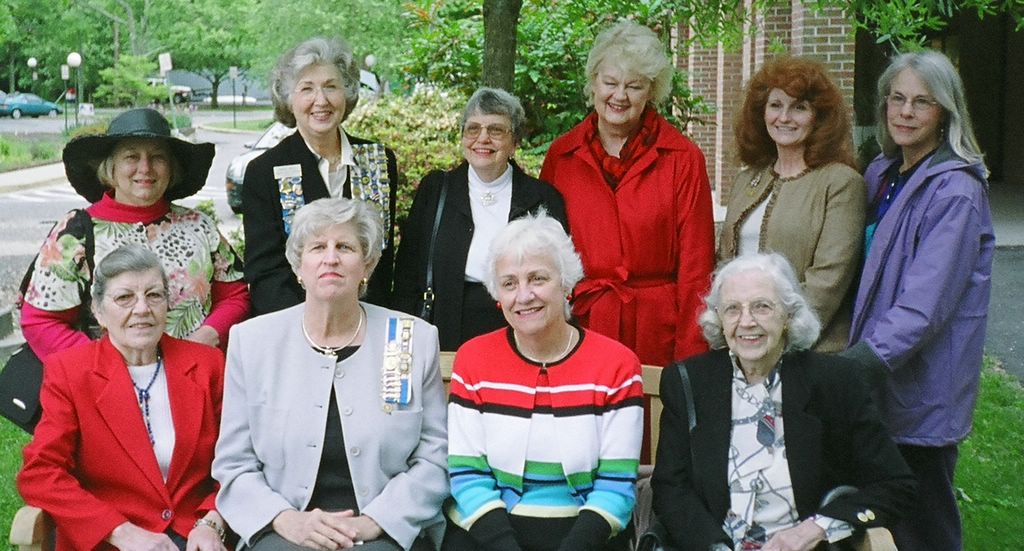
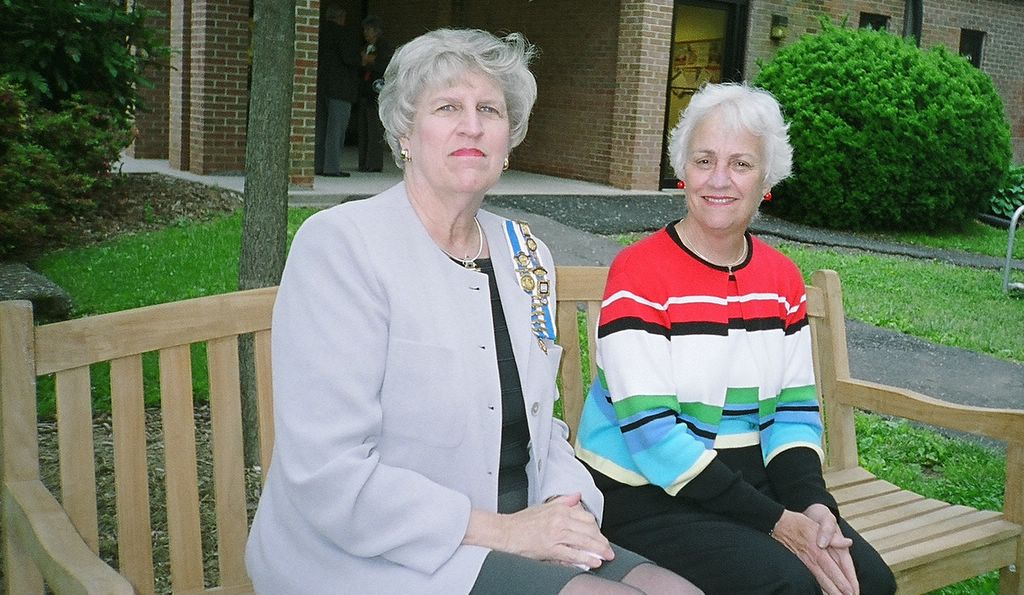
TO THE TOWN OF VIENNA, VIRGINIA - On Wednesday, May 25, 2005, at 12 Noon, at the Vienna Community Center, the FAIRFAX COUNTY CHAPTER of the National Society of the Daughters of the American Revolution (NSDAR), presented a teak bench to the Town of Vienna and to Mayor Jane Seeman. The bench was given to commemorate the 100th Anniversary, 1905–2005, of Fairfax County Chapter NSDAR of Vienna, Virginia.


|| Fairfax County Chapter Daughters of NSDAR at the ceremony, along with the Mayor of Vienna, Virginia ||

|| Fairfax County Chapter NSDAR Regent Martha Cole and Vienna Mayor Jane Seeman, seated at the new teak bench given to commemorate the centennial anniversary of the local DAR chapter, at the Vienna, Virginia Community Center. ||

ANSWERS

Here are the ANSWERS to the Attention Know-it-alls Quiz of 5/27/2005. If you have not taken the quiz, go there first and then come back to see how smart you really are.

1. The one sport in which neither the spectators nor the participants know the score or the leader until the contest ends ... boxing

2. North American landmark constantly moving backward ... Niagara Falls. The rim is worn down about two and a half feet each year because of the millions of gallons of water that rush over it every minute.

3. Only two vegetables that can live to produce on their own for several growing seasons ... asparagus and rhubarb.

4. The only sport in which the ball is always in possession of the team on defense, and the offensive team can score without touching the ball ... baseball.

5. The fruit with its seeds on the outside ... strawberry.

6. How did the pear get inside the brandy bottle? It grew inside the bottle. (The bottles are placed over pear buds when they are small, and are wired in place on the tree. The bottle is left in place for the entire growing season. When the pears are ripe, they are snipped off at the stems.)

7. Three English words beginning with dw ... dwarf,dwell,and dwindle.

8. Fourteen punctuation marks in English grammar ... period, comma, colon, semicolon, dash, hyphen, apostrophe, question mark, exclamation point, quotation marks, brackets, parenthesis, braces, and ellipses.

9. The original lakes referred to in Lakers ... in Minnesota. (The team was originally known as the Minneapolis Lakers, and kept the name when they moved west.)

10. Seven ways a baseball player can legally reach first base without getting a hit....taking a base on balls (a walk) ... batter hit by a pitch, passed ball, catcher interference, catcher drops third strike, fielder's choice, and being designated as a pinch-runner.

11. The only vegetable or fruit never sold frozen, canned, processed, cooked, or in any other form but fresh ... lettuce.

12. Six or more things you can wear on your feet beginning with "s"... shoes, socks, sandals, sneakers, slippers, skis, skates, snowshoes, stockings, stilts.

;

Monday, May 16, 2005

American Daughter Returns

Welcome back to American Daughter. She is reporting today that the American Daughter Media Center is back on line:
"Exactly twenty days ago, we had to leave our previous hosting situation for the Media Center due to excessive bandwidth usage. After much searching, we found a host that will give us ten Gigabytes per day. WE HOPE THAT WILL BE ENOUGH. After great effort, the American Daughter Media Center is up on the new servers."
Welcome back. We missed you.

Saturday, May 14, 2005

Podcasting the Internet

Podcast Alley! Isn't it amazing how this new technology is catching on in the blogosphere? Even more amazing; actually quite stunning it is that Catholic Insider is Number 4 of the "The Top 10 Podcasts for the month of May". I am a fan of Father Roderick, and it seems I am not the only one. It tells quite a bit about the spiritual health of the connected. On the Internet, there is no ACLU lurking about, shouting "Violations of Separation of Church and Internet!" Not yet, anyway. The Judeo-Christian tradition of showing all glory to God continues.

Notes from a Teacher writes:
... stories I’ve been following today point the way to the type of media I want for the future. ... I also want the personal journalism of people such as Father Roderick Vonhögen, a Dutch Catholic priest. I’ve been catching up on his Catholic Insider podcasts and among them was the one he recorded in in the hours following the announcement of the death of Pope John Paul II. Like any good journalist, Father Roderick took me to a specific place — St. Peter’s Square — at a specific time and shared with me what was happening at a momentous moment. He added to it his expertise and his humanity. And he layered it with his own reactions to the death of the pope. It left me with a greater understanding of the event than did the TV reports and newspaper stories.

Eamonn Fitzgerald calls Father Roderick "The Podfather".

... it may be too late for the newspaper business to recapture an audience that's heading for the exits. ... the kind of multimedia news that is becoming the next form of journalism is being assembled before our eyes. And here we come to the point of today's homily. Step forward Father Roderick Vonhögen, Catholic priest of the Archdiocese of Utrecht in The Netherlands. Trading as The Catholic Insider, he's "Podcasting from the heart of the Catholic Church", as he puts it. Talk about brilliant use of the new media to deliver niche news! This guy's simply astonishing. Text, images, audio... he does it, with passion and style. "Let me take you back to the night before the pope's funeral, and let's do a soundseeingtour of the streets around St.Peter's square, crowded with ten thousands of young people who travelled to Rome from all over the world." Love that "soundseeingtour", there. And now he's podcasting around the conclave. ...(T)he Father Rodericks are way ahead of the game. And they're only getting going. Pod on, padre!

Secret Worlds: The Universe Within

"View the Milky Way at 10 million light years from the Earth. Then move through space towards the Earth in successive orders of magnitude until you reach a tall oak tree just outside the buildings of the National High Magnetic Field Laboratory in Tallahassee, Florida. After that, begin to move from the actual size of a leaf into a microscopic world that reveals leaf cell walls, the cell nucleus, chromatin, DNA and finally, into the subatomic universe of electrons and protons."
Molecular Expressions: Science, Optics and You - Secret Worlds: The Universe Within - Interactive Java Tutorial:

Bartholomew Gosnold

At Jamestown, Virginia, America's "cradle of civilization", great preparations are underway for 2007, when they will celebrate the 400th anniversary of the first permanent English settlement in America. In order to extract a piece of DNA for analysis, the Church of England has agreed, for the first time in history, to allow excavation under the floor of a parish church where lay the remains of Bartholomew Gosnold's sister. Who was Bartholomew Gosnold, you ask? Even the director of archaeology for the Association for the Preservation of Virginia Antiquities, William Kelso, had never heard of Gosnold before 2002.
"He is the person without which Jamestown would not have happened. People talk about American history as if it started with Washington and Jefferson. But Gosnold was our founding grandfather. He's a lost part of American history."
If tests prove that the bones are Gosnold's, American history will be rewritten. Bartholomew Gosnold is unknown in both the United States and in Britain because history belongs to those who write it, rather than those who create it. The now famous Jamestown colonist John Smith, returned to England and spent the rest of his life writing about his leadership exploits in the Virginia colony. Overlooking the historic James River, in the center of the Jamestown fort, there now stands John Smith's statue. There is nothing to commemorate Gosnold. The excavation of the gravesite of "an important person" at Jamestown, Virginia may change the written history of America's founding.
U.K. Excavation May Rewrite U.S. History

Washington Post, JAMESTOWN, Va.
Bartholomew Gosnold might have been the founding father of what we now know as the United States, though his name and place in history have been buried in the passage of time and the importance that the swaggering adventurer John Smith attached to himself.

That could change soon. Two years after stumbling across a grave site holding the bones of a middle-aged man of high rank, archaeologists at the Jamestown settlement are about to learn whether the skeletal remains are Gosnold's.

Sunday, May 08, 2005

Happy Mother's Day


Happy Mothers Day

"I HELD a jewel in my fingers
And went to sleep.
The day was warm, and winds were prosy;
I said: ’T'will keep.'

"I woke and chid my honest fingers,—
The gem was gone;
And now an amethyst remembrance
Is all I own."

~~ BY Emily Dickenson

Thursday, May 05, 2005

Kicks on Route 66

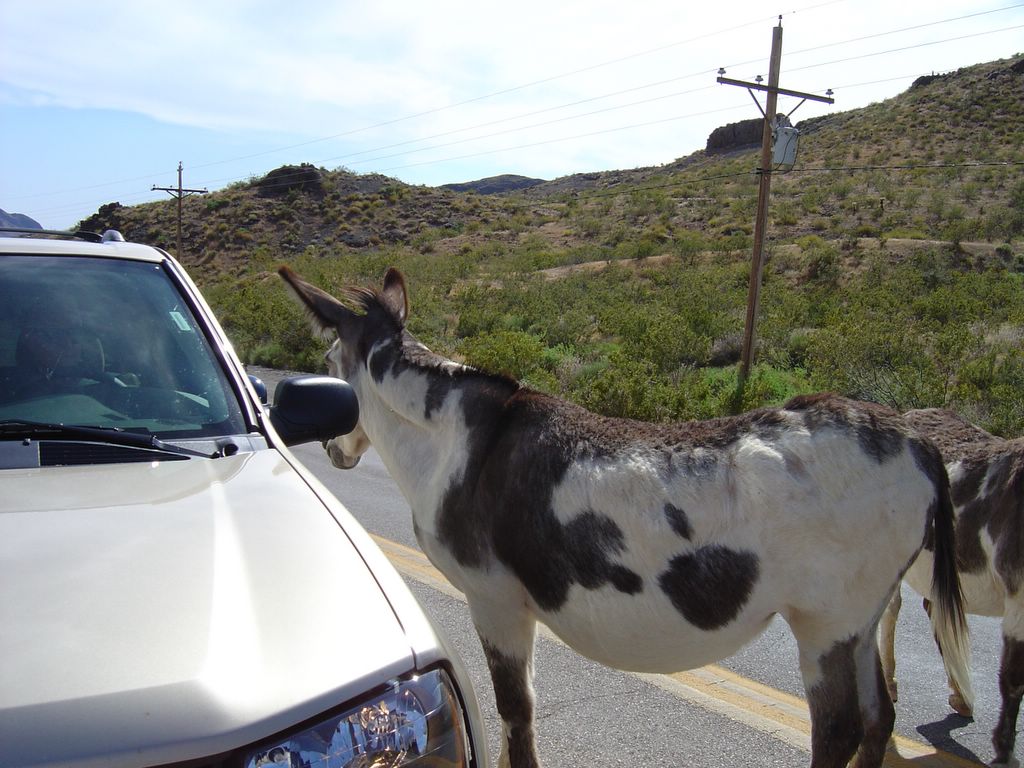
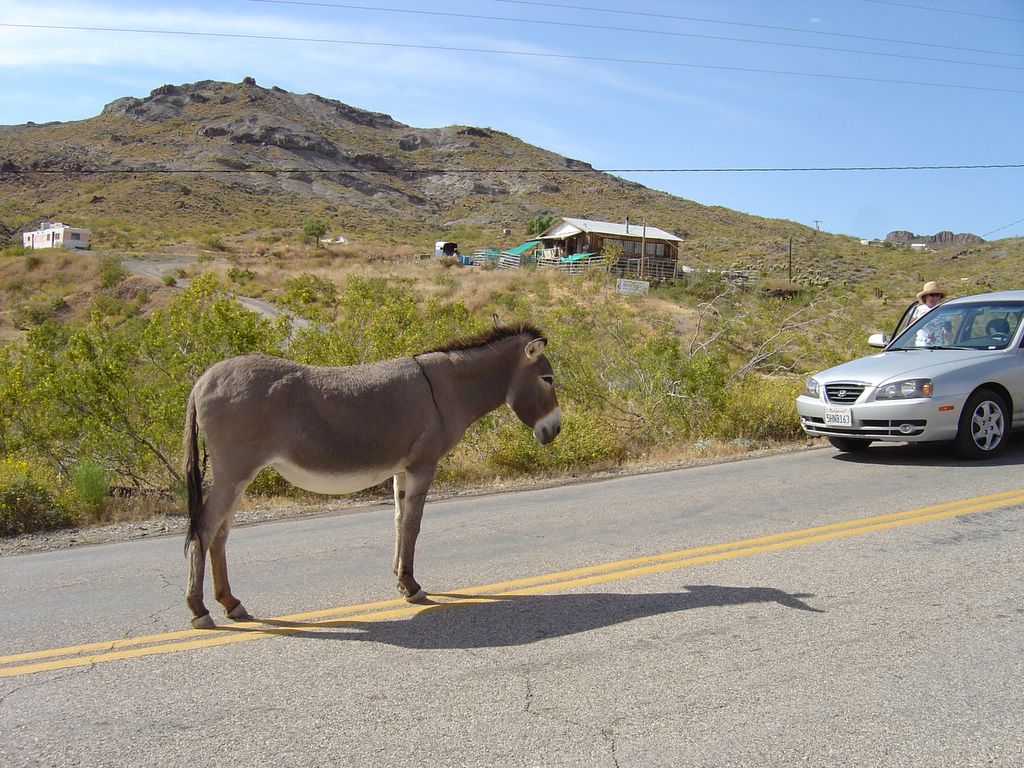
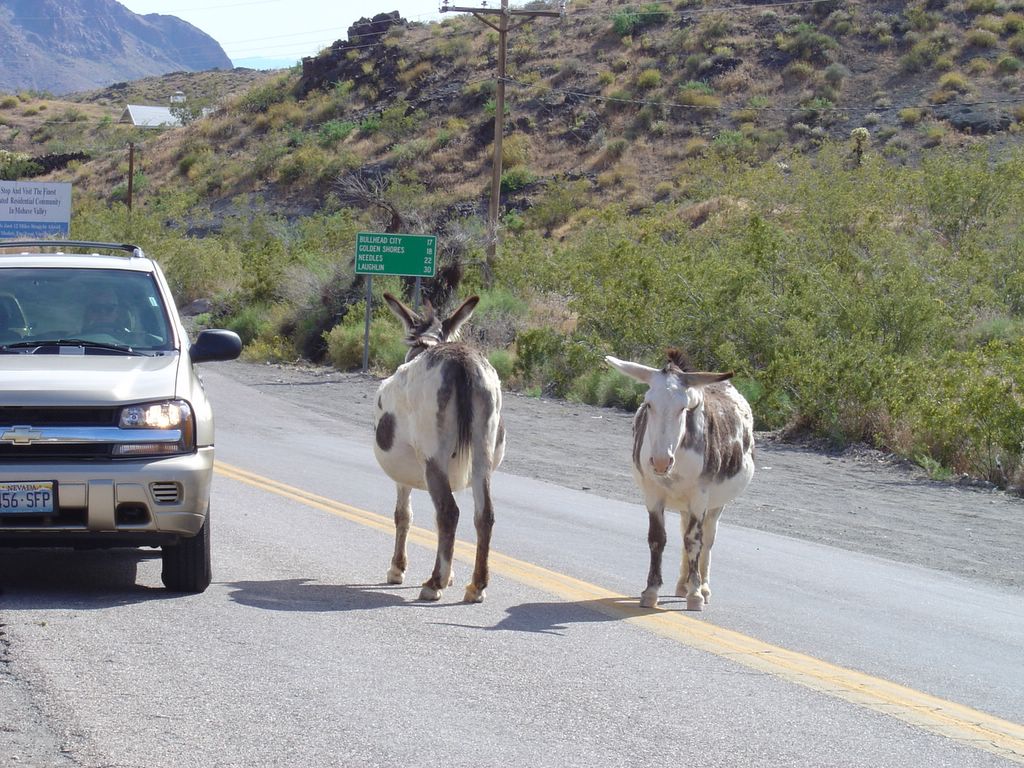
Is this what is meant by "Get your kicks on Route 66"? I was unaware that the wild burros now own the famous Route 66 that traverses the Mohave Desert, at Oatman, Arizona. Here is the proof as my husband attempts to navigate our SUV among them, and I try shooing the beasts from the highway while avoiding their bites and kicks, May 2, 2005. When I returned to our vehicle, one curious burro had his entire head in the car's passenger side, where I wanted to be.

|| The Burros Own Route 66

|| Wild Burros Left Behind by the Gold Miners on Route 66

|| This Guy is the Median Monitor of Route 66

|| Welcome to Oatman, Arizona - Home of the Wild Burros

, , ,

Tuesday, May 03, 2005

Who Are Rednecks?

Rednecks are progeny of the mighty Scots-Irish Presbyterians who pioneered the southern Appalachians and the American West. Few of today's Rednecks understand the true meaning and heritage of the word. This term originated with Lowland Scottish Presbyterians who would wear red scarves or stiff red collars around their necks, demonstrating that they were Covenanters, members of the National Covenant, which was the Scottish Presbyterian Church. They had literally signed their oaths with their own blood at Greyfriar's Kirkyard in 1638. For the wearing of their distinctive insignia, they received the pejorative appellation, Rednecks. For their refusal to accept the Church of England, which they described as "Popery without the Pope," these Scots were persecuted by the British. They fled first to Ulster, Ireland, then to America, where they became the Scots-Irish ethnic group. The word Redneck in early America referred to a descendant of those Scottish Protestants or, more generally, a southern Scots-Irish American. At the time of the American Civil War, the Yankees began referring to all white Southerners as Rednecks. Ironically, the nickname Yankee comes from the Dutch language and is based upon a word implying greed.

Many Americans attempt to slander not only this ethnic group, but the entire white South by using the appellation "Redneck." They are more to be pitied than confronted, and besides the term "Redneck" should be a badge of honor amongst true "Rednecks." It is a benediction from Heaven to be descended from people who were brave rebels and fighters against injustice; who were fearless in settling where others dared not - the Southern Highlands. They were staunch, freedom loving Presbyterians, who were opposed to slavery. Their ties of kinship were as tight as the clans of Scotland. They were extremely independent, industrious and at times, a bit boisterous. It is true they were known to be boastful and seemed to feel that naught but the trees were higher than themselves. They could certainly provoke disorder and loud talk when they disagreed with a thing, part of the reason they had been called “Crackers” in Ireland. They were "Rednecks", and we are too. And, by the way, y'all, we can take it!

THE NATIONAL COVENANT, 1639

THE SOLEMN LEAGUE & COVENANT

"Films that show poor whites as violent people who attack wealthy citified whites allow the rich to justify their treatment of 'white trash' by portraying the poor whites as racist, criminal and uneducated. This allows other typically marginalized groups to join upper class whites against the "white trash." This justifies upper class stereotyping of poor whites and serves to aid in relieving upper class white guilt over treatment of 'others' in the past. The hatred and condescension of the poor seems to be the last available method of prejudice in our society. Just as Americans have made an effort to educate, understand and alter the treatment of marginalized groups and alternate cultures within our society, we have held on to poor whites as a group to demean." ~~Angel Price of Virginia University

"Rednecks ... legacy is stained because he became the dominant culture in the South, whose economic system was based on slavery. No matter that the English aristocrats of Tidewater were slavery's originators and principal beneficiaries or that the typical Scots-Irish yeoman had no slaves." ~~James Webb, Parade Magazine, 3 October 2004

"the 'redneck' stereotype is especially fitting because it fills all the scapegoat requirements: biological differences --inbred, less intelligent, unattractive; geographic and regional differences --trailer parks, rural south, hillbilly; economic differences -- poor, sick, lazy, dirty; cultural differences-- fundamentalist, superstitious, loud, kin networks; and moral differences-- trashy, racist, violent." ~~Jim Goad, Redneck Manifesto

"Born Fighting is a bombshell – or else the most brilliant battle flare ever launched by a book. James Webb reveals the all-but-invisible ethnic group that has created the core beliefs of democracy American style: our rights come from God not the Government; all of us are born equal and ‘born aristocrats’ don’t exist; and tread on either of those two truths, and we’ll fight you down to the last unbroken hyoid bone. The Scots-Irish (for such is their name) have fought all our wars for us, including Vietnam. James Webb was there, and he can count. He has written not only an engrossing story but also an important work of sociological history in the tradition of the great James Graham Leyburn.” ~~TOM WOLFE
What You Need to Know About the Scots-Irish by James Webb.
Born Fighting : How the Scots-Irish Shaped America

, ,

Housecleaning Philosophy

I don't do windows because ...
I love birds and don't want one to run into a clean window and get hurt. (I am compassionate.)

I don't wax floors because ...
I am terrified a guest will slip and get hurt, I'll feel terrible, and they may sue me. (I am careful and poor.)

I don't mind the dust bunnies because ...
They are very good company, I have named most of them, and they agree with everything I say. (I am imaginative.)

I don't disturb cobwebs because...
I want all creatures, including spiders, to have homes of their own. (I am kind.)

I don't Spring Clean because ...
I love all the seasons and don't want the others to get jealous. (I am fair minded.)

I don't pull weeds in the garden because ...
I don't want to get in God's way. He is an excellent designer. (I am courteous.)

I don't put things away because ...
My family will never be able to find them again. (I am considerate.)

I don't cook gourmet meals when I entertain because ...
I don't want my guests to stress over what to prepare when they repay my dinner invitation. (I am thoughtful.)

I don't iron because ...
I choose to believe the promise of "Permanent Press." (I am trusting.)

I don't stress much on anything because ...
"A Type" personalities die young and I want to stick around and become a wrinkled up crusty ol' woman. ~~Internet Author Unknown

Housecleaning for Nerds

Wednesday, April 27, 2005

Redskins and War Paint

Red Was the Color of War

The image is of William "Lone Star" Dietz, whose mother was a full blooded Sioux Indian. Dietz was the first coach of the Redskins football team, and it was in his honor that the team was named "Redskins". He brought a number of Indian players with him to the team and they wore war paint and Indian bonnets at games. There seems to be no etymological evidence that the word "redskin" originally meant anything other than "an aborigine with red skin". According to Take Our Word For It, the earliest recorded use of the word was found in a quotation from 1699: "Ye firste Meetinge House was solid mayde to withstande ye wicked onsaults of ye Red Skins."

Most people assume that the word described the natural skin color of the North American Indians. However, there exists documentation that the name "redskin" was conferred upon the native inhabitants by the English Colonists because of the red body paint they wore in battle. Because the 1699 quotation would certainly be referring to Indian warriors, this seems to be the most likely explanation of the origin of "redskin"..

Some say the term is disparaging. The "Webster's Third New International Dictionary", Unabridged, 1976, gives "a North American Indian" and nothing more. The Oxford English says "redskin" is "generally benign". If the origin of the word had to do with painted warriors in battle, I find it suspect that it would have become an insult. Yet, beginning about 1967, dictionaries began to describe it as "usually offensive".

There are other early instances in history when the native Americans were described as "Red Indians" by the British. This too seems quite innocent, as it was necessary to differentiate them from the East Indians. In "The History of Our Country" by Edward S. Ellis, copyright 1918, volume 1, page 12, the author writes in awe of the American Indians of the Colonial period.
"General Cook has seen Apache scouts trot fifteen hundred feet up the side of a mountain, without showing any increase of respiration or sign of fatigue. The Indians trained their bodies from infancy to repress all expression of pain, even when suffering the tortures of death. They underwent hunger, thirst and fatigue without a murmur. ... they were merciless in war, and inflicted frightful cruelties upon their prisoners."
The author continues speaking of the admirable traits of the native people, "The exploits of some of the red men in this respect seem incredible."

How did it come to be that the football team in Washington D.C. is named "The Redskins"? Marc Fisher, Metro Columnist for the Washington Post, 2002, explains saying that the official story is that when the Boston Braves football team left Braves Field to play at Fenway Park in 1933, the owner needed to find a new name for his squad. He chose Redskins in honor of Lone Star Dietz, the team's coach and an Indian who often wore an eagle feather headdress, beaded deerskin jacket and buckskin moccasins. Dietz brought four to six -- accounts vary -- Indian players with him to Boston from the Haskell Indian School in Kansas, where he had coached for four years.

Another version has the team being named for the white men who dressed up as Indians to stage the Boston Tea Party at the start of the American Revolution. Yet another genesis story says the name stems from the colored clay that Plains Indians used to paint themselves for tribal ceremonies.

Whichever version is accurate, "the reality is more benign than people on both sides of the fence are attributing to it," says sports historian and museum consultant Frank Ceresi. "The name was meant very, very positively."

The genesis may always remain murky ... . But it is clear that the Boston Redskins, who moved to Washington in 1937, sought to capitalize on their Indian players and coach: The team played wearing red war paint. And Indian players from the time considered the name and trappings an honor.
From Boston Redskins 1932-1936:
"1933: Now led by Lone Star Dietz, a Native American Coach, the team moves to Fenway Park. With the move the team also undergoes a name change becoming the Boston Redskins. The Redskins would alternate wins and losses all season and would finish with a 5-5-2 record."
It is quite unfortunate that so many people have accepted the concocted story that the word "redskin" comes from the white man paying bounties for Indian scalps. Some versions of this hoax are ridiculous, such as one published in The Virginian-Pilot (N.C. school districts rethinking use of Indian mascots, By CATHERINE KOZAK, March 29, 2003), which says
"The word Redskin is considered derogatory. The term comes from centuries ago when a bounty was placed on Indian people. Trappers would bring in Indian scalps along with the skins of animals -- bearskin, deerskin, redskin. For Indians, it is a reminder of their genocide".
It strains credulity that fur traders would be collecting scalps of Indians. Here is another blatantly false version by a Spokane Indian woman, Dr. Charlene Teeters.
"Redskin was the shorthand name for a body part like a scalp or hands, of Native American people who were slaughtered to collect bounty payments. The symbol used to mark the locations where bounty hunters could collect payments was the decapitated head of a Native American, not unlike those symbols often used by sports teams."
The term "redskin" has been in use since at least as early as 1699. The British government did not offer bounties for scalps until more than fifty years later, during the French and Indian War. For our erudition, some soul has created a list of all the known slur words in the English language, so if you want to be safe in your speech and writing, go here. For a more indepth study of William Lone Star Dietz including a collections of photographs of him in Indian dress, go here.

Red Was the Color of War

Face Painting

, , , ,


This story was revised on 12 August 2021, to correct broken links.

Tuesday, April 26, 2005

Believe It or Don't

On this day, 26 April 1944, the women of France received the right to vote. Men had received universal suffrage more than one hundred years earlier, in 1848. In the United States of America women have had the right to stand for election since 1788; a very progressive stance for the new democracy, yet, according to this timeline, rank and file women could not vote here until 1920.

Both my mother and grandmother could not vote when they were born in Virginia. When I was born, women were still being denied the vote in that most civilized of nations, France. What a long way we have come!

Women's Suffrage Timeline gives the following facts. Full suffrage was not granted to women of Liechtenstein until 1984 (more). In 1984, South Africa extended voting rights are extended to Coloreds and Indians (more), and finally to black women in 1994 (eleven years ago more). Women's Suffrage
, ,

Thursday, April 21, 2005

Habemus Papam

What a blessing it has been to witness these marvelous happenings; the releasing of the sainted John Paul to his heavenly home, and the new Pope being chosen by God through the cardinals. It is such a mysterious manner of ordaining a new leader for the great church of Christendom. Such conclaves have been assembled from time out of mind and we continue following the ancient path. We connect to our forbears still, in simple ways. "Habemus Papam!" How many times have those words been a great sense of comfort to the faithful? What a joy it has been to hear Father Roderick's podcast in the midst of the great Saint Peter's Square. This tradition has been followed for almost two thousand years. Simon Peter was a disciple of Jesus, and during his short time on earth, Jesus planned for him to become the shepherd of His flock. The fisherman from Galilee was given the keys to the kingdom of heaven. This follower and friend of Jesus became the first Pope, when Jesus said to him: "You are Peter and upon this rock I will build my church."

I hear the chants from Saint Peter's Square; "Viva Papa, Viva Papa". There rings hope in the hearts of the faithful. There is faith in the hearts of the followers that the new Pope Benedict is God's chosen one. The first Pope, Simon Peter, made his way to Rome, and his successor Popes remained there, with their Church. What a wonderful and sweet heritage for Christians to know that this new Papa is another link in the chain of our human history. These are the ties that bind us to our past and to the primordial rituals of humankind.

O Papa Novo is a German. John Paul was a Pole. There was even in the long, long ago, an English pope, Nicholas Breakspear, known as Pope Hadrian IV. He was elected in 1154 and was the first pontiff to be known by the title "Vicar of Christ".

Listen Here to Father Roderick's Pod Cast while watching and waiting for the "White Smoke".

From Saint Peter, Prince of the Apostles, descending the ladder of two thousand rungs, to Pope Benedict XVI, there have been 265 Popes, including some anti-Popes. See the List of Popes. May peace be upon you and yours from this day forth.

Wednesday, April 20, 2005

Language Profiling

This is fun! I'm a mixture - 30% General, 30% Yankee (must be from my youth in Maryland, as I have never lived in Yankeeland), 25% Dixie and 10% Upper Midwestern (that must mean Western US where I have spent some time). This is from It'sAPundit.com:
I was bored. And I couldn't find my mirror so I could admire myself. So I looked at other blogs instead of reading this blog over and over again. I saw a link on Basil's Blog that led me here. And a post there led me here. And I took the survey. And my language is perfect. Witness this: What Kind of American English Do You Speak?


Neddy's Linguistic Profile:


30% General American English

30% Yankee

25% Dixie

10% Upper Midwestern

0% Midwestern

Tuesday, April 19, 2005

Primrose Day ~ April 19th

"Oh! who can speak his joys
when Spring's young morn
From wood and pasture
opened on his view,
When tender green buds blush
upon the thorn,
And the first Primrose dips
his leaves in dew." ~~ Clare

The Greek name of the Primrose was Paralisos, so-called after a youth who died of grief for the loss of his betrothed and was changed into the flower.

In Germany it is call the Key Flower on account of the legends of its power to open doors to marvellous treasures.

In old England it was credited with the power of showing to lovers whether or not they would win the objects of their affections.

The Primrose blooms in spring and early summer. In astrology it is an herb of Venus.

At the Tate Gallery, there is a lovely artistic rendering of a young girl gathering primroses in her bonnet, painted by Frank Bramley; Primrose Day (1885). In this work, hanging on the wall, is a print of the conservative statesman and prime minister, Benjamin Disraeli, for whom was inaugurated.

Upon this primrose hill
Where, if Heav’n would distil
A shower of raine. Each several drop might goe
To his owne primrose, and grow manna so.

~~John Donne, 1572-1631

Thursday, April 14, 2005

The Puritans Got It Right!

It is as I have always suspected in my Puritan heart, and now the Pope has confirmed it. "The Onion" has the latest scoop:
Heaven Less Opulent Than Vatican, Reports Disappointed Pope

The Onion, 13 April 2005, HEAVEN — The soul of Pope John Paul, which entered heaven last week following a long illness, expressed confusion and disappointment Saturday, upon learning that the Celestial Kingdom of God to which the departed faithful ascend in the afterlife is significantly less luxurious than the Vatican's Papal Palace, in which the pope spent the past 26 years of his earthly life.

"Up here, everyone is equal," John Paul II said. "No one has to go through an elaborate bowing ritual when they greet me. And do you know how many times my ring has been kissed since I arrived? None. Up here, I'm mingling with tax collectors, fishermen, and whores. It's just going to take a little getting used to, is all."

The pope said it is amusing to think that he has been waiting for this "so-called Paradise" his entire life. "I spent almost 84 years reciting novenas and Hail Marys to get to this restful place," John Paul II said. ... "Frankly, this afterlife represents a significant drop in my standard of living. Well, they always said you can't take it with you," he added.
, , ,

Tuesday, April 12, 2005

Sunday, April 10, 2005

Time Travel

An ex-Confederate soldier, Samuel Langhorne Clemens, gave a clue as to how mental time travel might be accomplished. In 1896, Clemens, using a pseudonym, wrote:
"There is in life only one moment and in eternity only one. It is so brief that it is represented by the fleeting of a luminous mote through the thin ray of sunlight - and it is visible but a fraction of a second. The moments that preceded it have been lived, are forgotten and are without value; the moments that have not been lived have no existence and will have no value except in the moment that each shall be lived. While you are asleep you are dead; and whether you stay dead an hour or a billion years the time to you is the same." ~~Mark Twain
Civil War reenactor Jonah Begone tells us how to do it.
"Try this: find the most authentic surroundings you can. Go someplace where nothing makes any fingerprints on your window into the past. Sounds are important. You need the clanking of pots and pans and the murmuring of troops in the field. (Some sounds, like old bits of music, cause me to travel back mentally in an instant. A moment later, the effect is gone.) Smells are evocative, too: leather, black powder, sweat, wool, campfire smoke, straw, the smell of a field in the summer. Now, do something that is universal to the experience of humanity. Kiss a young woman for the first time. Or, run until you are overheated and badly out of breath. Or experience the kind of pain that makes you oblivious to anything other than your present condition. For the moment that you forget the past and the future and live just in that moment, you are experiencing exactly the same thing that someone 135+ years ago has done, and it no longer matters what year it is.

"Reenactors do this all the time; we call it time-tripping. But it only lasts briefly. As soon as you think, "Wow, this must be like it must have been," you have taken a subjective stance that ends the moment. It takes a high degree of delusion to sustain the moment, and I'm not even sure we would want to. Fooling others is acting; fooling ourselves is folly.

"In the seventeen years I have reenacted the American Civil War I can add up all those moments from each season, when the black powder smoke blows forth from the muskets in the first events in April to the last smells of the camp as it is being taken down in October or November. I would be hard-pressed to figure out which moment was supposed to be First Manassas and which was Gettysburg, or Antietam. But it doesn't really matter, and I am glad for them all. I suppose the Civil War veteran's recollections of the war is much like my recollections of reenacting it, which goes a long way to a claim of authenticity, despite the fact that I was wearing modern underwear all the while."

Saturday, April 09, 2005

Golden Daffodils 1804

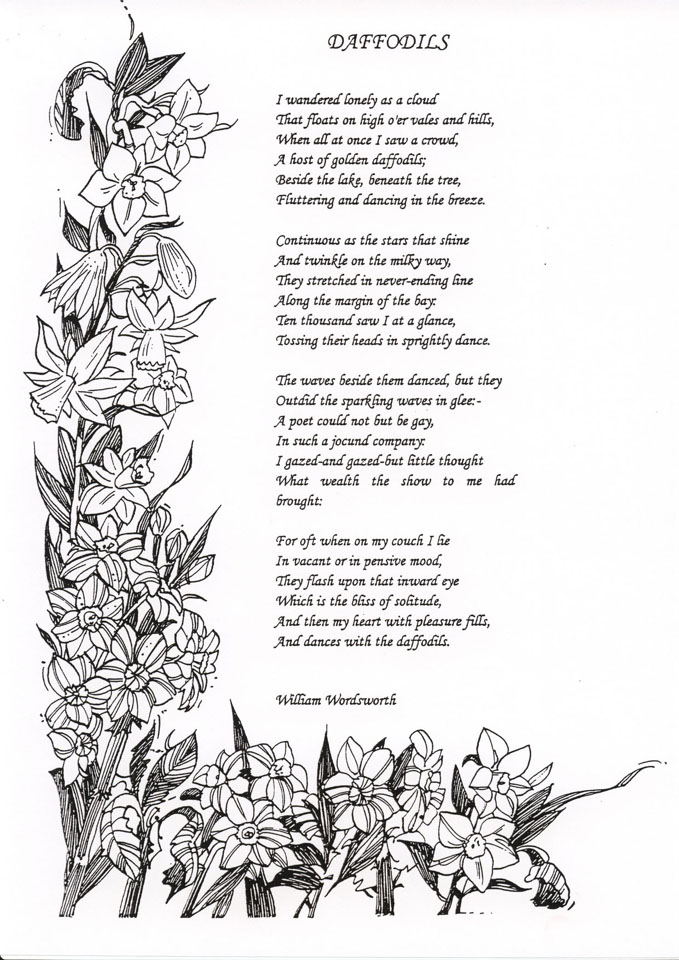
Daffodils by William Wordsworth (1770-1850) (Click Picture to Enlarge) I WANDER'D lonely as a cloud That floats on high o'er vales and hills, When all at once I saw a crowd, A host, of golden daffodils; Beside the lake, beneath the trees, Fluttering and dancing in the breeze.

Wild Daffodils

Perhaps my mystery daffodil is the "Queen Anne's double jonquil" that I found here: Species Daffodils, Wild Variants, and Wild Hybrids. I don't really think so, because mine has only one bloom per stalk, but after reading their description of these wild daffodils, I do believe that is what I've got from the Via homestead. I wonder where Grandmother Via found the wild jonquils. I do not believe they were native to the Virginia mountains, or were they?


It could be the Double Campernelle; or, Queen Anne's Double Jonquil, although mine is not as pretty as the illustration. I know it is not the 'Rip Van Winkle', as that one is a miniature daffodil, from 1884. Mine is not miniature and I believe it to be older.

THE UNBEARABLE LIGHTNESS OF DAFFODILS

Grandma's Daffodils


Grandma's Daffodils ~ CLICK picture to see Close-Up

Here is a very special daffodil, narcissus, or jonquil; I'm not certain which. I transplanted a few bulbs from my Grandma Via's front garden near Doyle's River at the foot of the Blue Ridge Mountains. On this April day, those bulbs are blooming in my garden, about 150 miles north as the crow flies, high above Pohick Creek. I would really like to know which Grandma Via planted them, as four generations of my Via ancestors lived there. It could have been Grandmother Sally Turk Via whose husband served in the War of 1812 and who probably built the house. I know for certain that their youngest son raised his family there, so it could have been my Grandmother Susan Walton Via. Her husband should have fought for Virginia in the "War of Northern Agression", but he didn't, and that is a whole other story. Or even my great grandma Mollie may have put them in, as she lived there taking care of Grandmother Susan in her final years, in the early 1900s.

I am wondering if anyone recognizes this flower species, as it seems quite unusual. It lacks the center trumpet usually seen in daffodils and jonquils, and instead has many ruffled petals. The outside petals, and some inner ones are green, rather than the usual yellow. If you can, please help me solve my daffodil mystery.

Friday, April 08, 2005

Fresh Tomatoes and Salmonella

Now we learn that besides undercooked eggs, raw milk and meat, we can also be laid low with Salmonella poisoning by eating fresh tomatoes. The bacterium is not only on the skin of the fruit, it can be inside the flesh of the tomato, therefore it can only be destroyed by heat. We have to cook them! Eh? Will they still be fresh tomatoes? No, but,not only will cooking them save us from Salmonella, but Cooking Tomatoes Boosts Disease-Fighting Power.

Tomatoes Blamed for Sickening 561

Roma Tomatoes Linked to US, Canadian Salmonella Outbreaks

Thursday, April 07, 2005

Last Respects to John Paul II

Father Roderick set his alarm to awaken at 3 am so that he and another Dutch priest could bicycle to Saint Peter's basilica to pay their last respects to "this great pope", as he says. Father made a podcast, which you may enjoy, as it makes you feel that you are on the journey with him, at the Vatican in the heart of the historic night.
Catholic Insider April 5, 2005 - Last farewell to John Paul II

Stars & Stripes on Saint Peter's Square, (The Audio)

Tuesday, April 05, 2005

Feed My Sheep

This is now the third time that Jesus shewed himself to his disciples, after that he was risen from the dead.

So when they had dined, Jesus saith to Simon Peter, Simon, son of Jonas, lovest thou me more than these? He saith unto him, Yea, Lord; thou knowest that I love thee. He saith unto him, Feed my lambs.

He saith to him again the second time, Simon, son of Jonas, lovest thou me? He saith unto him, Yea, Lord; thou knowest that I love thee. He saith unto him, Feed my sheep.

He saith unto him the third time, Simon, son of Jonas, lovest thou me? Peter was grieved because he said unto him the third time, Lovest thou me? And he said unto him, Lord, thou knowest all things; thou knowest that I love thee. Jesus saith unto him, Feed my sheep. ~~John 21:14-17

Feed My Sheep(msm)

The Night the Pope Died

Father Roderick rides his bicycle to Saint Peter's Square where the Rosary Prayer had just finished being prayed by the people, when the great Pope John Paul died. Bells begin to be heard as the priest tells us that soon bells all over Rome will be ringing out his death, and then bells will be heard all over the entire world.
"This special podcast is dedicated to the events surrounding the death of pope John Paul II in the evening of April 2, 2005. You will hear how the bells of Rome announce the death of the pope, and I will take you to Saint Peter's Square where we will experience the emotions of the crowd gathered there in prayer and grief." ~~Father Roderick Vonhögen, catholic priest of the Archdiocese of Utrecht, The Netherlands
April 2, 2005 - The Night the Pope Died (mp3)

Monday, April 04, 2005

Berkeley Plantation


Berkeley Plantation, Charles City, Virginia
If Only Walls Could Talk - what amazing tales our ears would hear inside the lovely plantation home of Berkeley. In 1619, early English settlers came ashore at Berkeley Hundred, naming it in honor of their home seats. On December 4th of that same year, the colonists observed the first official Thanksgiving in America, before the Mayflower Pilgrims had even left England. On Good Friday of 1622, while celebrating with their Indian friends, Opechancanough's men rose up and attempted to massacre all the whites in Virginia, and they almost suceeded. Giles Bland was an early owner of Berkeley Hundred, and after he was executed for complicity in Bacon's Rebellion, the Harrisons assumed ownership. This hallowed ground, situated above the historic James River, is a treasure for all Americans, as it has witnessed and participated in the entire history of our nation.The original brick mansion, which still stands, was built in 1726, of brick fired right on the plantation. Here was born Benjamin Harrison, son of the first owner and builder of Berkeley, who signed the Declaration of Independence and was a three-time Governor of Virginia. His son, William Henry Harrison, also born at Berkeley, was governor of the Indiana Territory and became the ninth President of the United States. His grandson, Benjamin Harrison, became the 23rd President and was the husband of Caroline Lavinia Scott Harrison, a founder of the Daughters of the American Revolution and its first President General. George Washington, and the nine succeeding Presidents of the United States, all visited at Berkeley, and dined in the same dining room that still overlooks the James River today. The British troops of the traitorous Benedict Arnold plundered the plantation during the American Revolution, although no serious harm was done to the mansion. During the Civil War, Union troops of the Army of the Potomac occupied Berkeley Plantation, and President Abraham Lincoln twice traveled via water from Washington to review them. It was here that General George B. McClellan was relieved of command by Lincoln. There are ten acres of terraced boxwood gardens and lawn extending a quarter-mile from the front door to the James River. It was a special treat for me to visit this wonderful Virginia shrine, that has been owned and maintained privately.

Friday, April 01, 2005

Saint Peter to John Paul the Great

And I say also unto thee, That thou art Peter, and upon this rock I will build my church; and the gates of hell shall not prevail against it. ~~Matthew 16:18

Death's Springtime Rendezvous

We continue our watch of the Passion Play which has been unfolding before our awestruck eyes since the approach of Easter Week. We watched an innocent child of God, a daughter of mother Mary, die an unnatural death decreed by the Culture of Death. We witnessed her cheated of God's time and God's will by the acolytes of the Evil One, to become a martyr for the imperfect. Now we watch the great Pope, the saintly John Paul II, approach the veil of death. We watch a natural death, a death walked in God's way. We pray for John Paul the Great as he winds his way to Heaven. We pray also for ourselves; that our own rendezvous with death will not be hastened by the law of the land.
I HAVE a rendezvous with Death
At some disputed barricade,
When Spring comes back with rustling shade
And apple-blossoms fill the air—
I have a rendezvous with Death
When Spring brings back blue days and fair.

It may be he shall take my hand
And lead me into his dark land
And close my eyes and quench my breath—
It may be I shall pass him still.
I have a rendezvous with Death
On some scarred slope of battered hill,
When Spring comes round again this year
And the first meadow-flowers appear.

God knows 'twere better to be deep
Pillowed in silk and scented down,
Where love throbs out in blissful sleep,
Pulse nigh to pulse, and breath to breath,
Where hushed awakenings are dear...
But I've a rendezvous with Death
At midnight in some flaming town,
When Spring trips north again this year,
And I to my pledged word am true,
I shall not fail that rendezvous.
~~Alan Seeger (1888–1916)
[death, Pope, Schiavo, poetry]

Happy April Fool's Day

"The first of April is the day we remember what we are the other 364 days of the year. " ~~ Mark Twain
In sixteenth-century France, the start of the new year was observed on April first. It was celebrated in much the same way as it is today with parties and dancing into the late hours of the night. Then in 1562, Pope Gregory introduced a new calendar for the Christian world, and the new year fell on January first. There were some people, however, who hadn't heard or didn't believe the change in the date, so they continued to celebrate New Year's Day on April first. Others played tricks on them and called them "April fools." They sent them on a "fool's errand" or tried to make them believe that something false was true.[humor, April Fools, Gregorian Calendar]